
Threat modeling is a structured way to ask what could go wrong in a product and what to do about it. A small team can begin with one important feature and a simple drawing. The value comes from connecting possible problems to design decisions, not from producing a complicated diagram.
Understand the idea
Draw the users, services, information, and boundaries between them. Choose a sensitive action and ask who should perform it, what the system trusts, and how it handles a failed or repeated request. Record assumptions so someone can later test whether they are true.
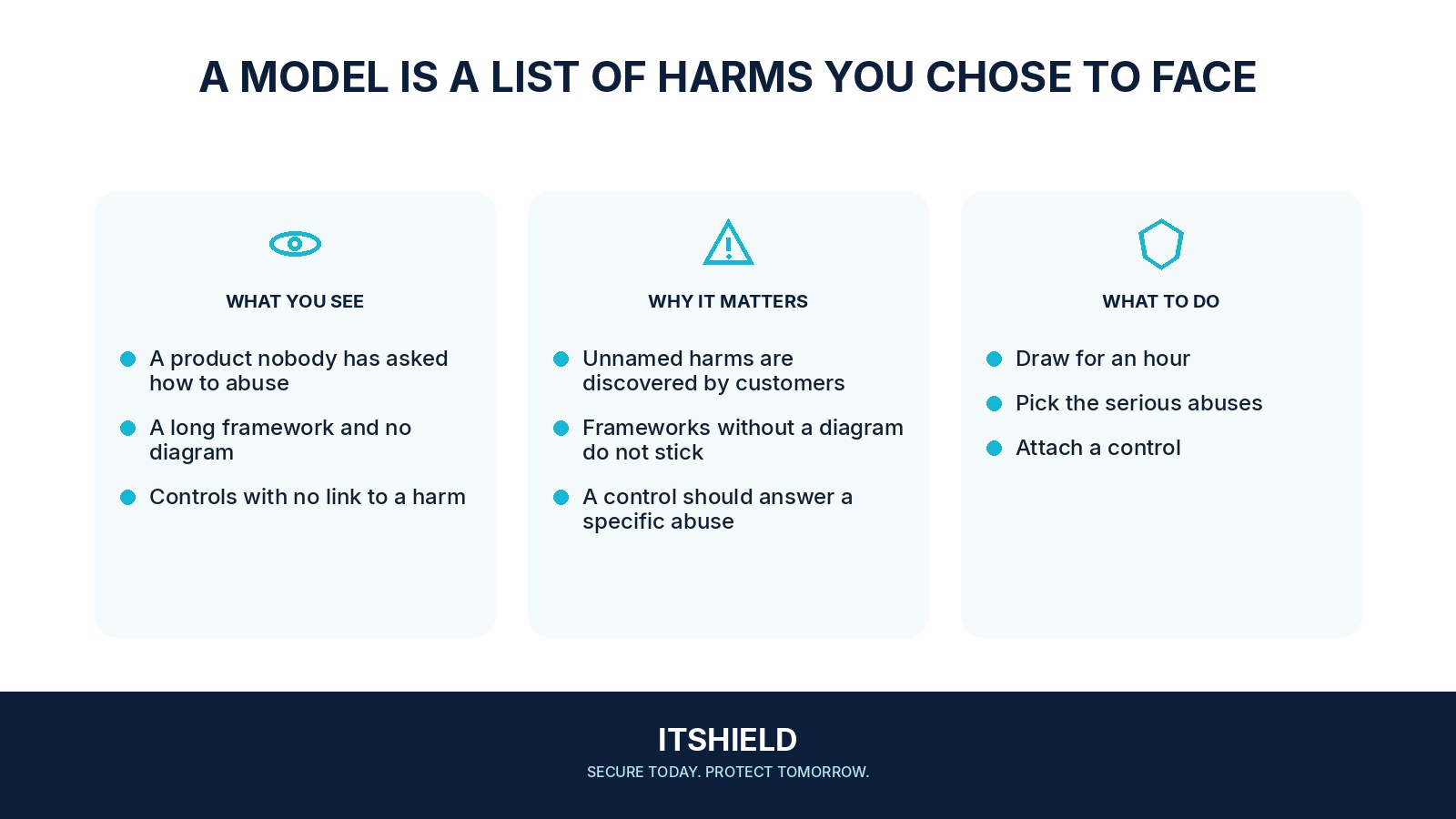
- Journey
Draw the people, services, and information involved.
- Misuse
Identify where authority or data could cross the wrong boundary.
- Control
Choose a small set of owned, testable improvements.
A practical example
Imagine a team reviewing a file-sharing feature. It asks who may create a link, whether the recipient must sign in, and what happens when a link expires. These questions lead to specific access rules and tests before the feature becomes part of everyday work.
What to do next
- What information, capability, or business outcome must we protect?
- Who can initiate the workflow, and what identity does each component trust?
- What happens with the wrong user, a repeated request, an interrupted step, or an unavailable dependency?
- Which control prevents or detects the unwanted result?
- How will we test that control and who owns the work?
How to check the result
Turn the important findings into owned design changes or tests. Revisit the model when a new integration, user role, or information flow changes the original assumptions.
Do we have to model the whole product before fixing anything?
Use a bounded journey with a clear consequence. Record the scope and uncertainties, then expand the model as you learn more.
Sources and useful guides
The following resources provide background and more detailed guidance. Use the sections that match your service and situation.