
A tabletop exercise asks a team to discuss an incident and make decisions without disrupting live systems. It becomes useful when participants must use their real contacts, authority, and information. A rehearsed story with no decisions may feel smooth while leaving important gaps undiscovered.
Understand the idea
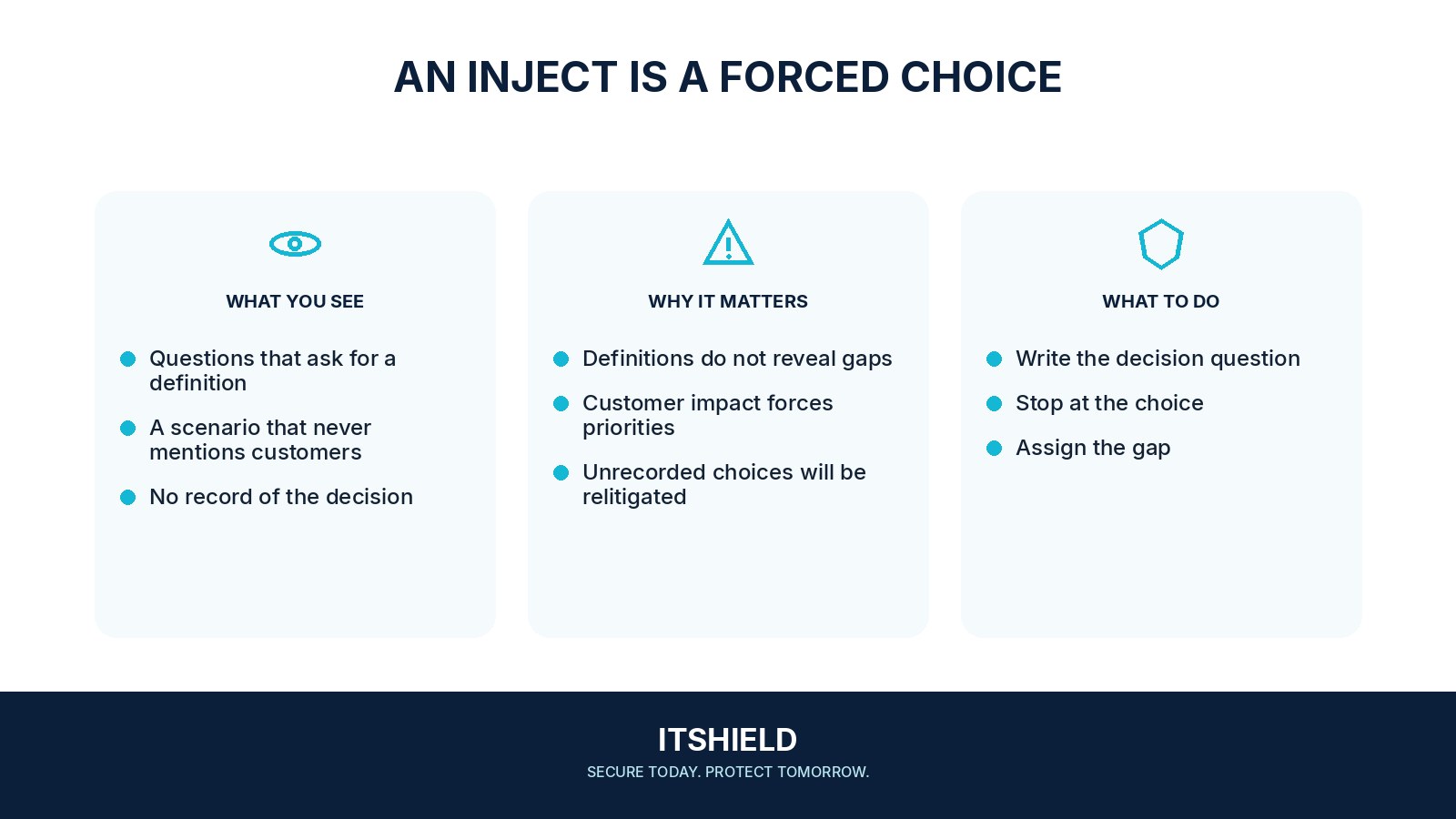
Choose a situation that affects an important service and introduce a few changes to the story. These changes are often called injects. Each should ask for a decision: who may stop the service, contact a supplier, approve recovery, or communicate an uncertain finding? Record what information was missing.
- Decision
Choose a meaningful operational dilemma.
- Inject
Introduce information that changes or constrains the choice.
- Debrief
Turn the gaps into owned improvements and follow-up checks.
A practical example
Imagine a ransomware scenario where the usual incident lead is unavailable. The next update says the backup cannot yet be verified. Participants must choose an acting lead, decide what to keep offline, and agree who will update staff while uncertainty remains.
What to do next
- Choose a service and decision. Select an incident that could affect real work, and identify which choices participants must practise.
- Add a realistic complication. Make a key person unavailable, delay backup verification, or introduce an uncertain report that changes the decision.
- Record the reasoning. Capture who could decide, which information they needed, and where the contact or approval process became unclear.
- Assign and retest changes. Choose a few practical improvements and test them at the next suitable opportunity.
How to check the result
End with assigned corrections and evidence needed to close them. At the next exercise, test the changes that were promised rather than starting with an unrelated scenario.
Participants describe a plan but avoid choosing an owner.
Ask who can authorize the next action and what happens if that person is unavailable. Record unresolved authority as an exercise outcome.
Sources and useful guides
The following resources provide background and more detailed guidance. Use the sections that match your service and situation.