
DMARC is an email policy that helps receivers assess messages claiming to come from your domain. It works with SPF and DKIM, two ways of checking mail sources or signatures. For a small organization, the practical first step is to identify every legitimate service that sends its email.
Understand the idea
A domain may send mail through office accounts, a newsletter platform, a website form, and a billing service. These routes need suitable authentication and alignment with the domain in the visible From address. Publishing a strict policy before checking them can disrupt genuine mail.
- Inventory
List every service that sends mail using your domain.
- Observe
Review SPF, DKIM, alignment, and reports.
- Enforce
Increase policy strength after resolving legitimate failures.
A practical example
Imagine an NGO preparing a DMARC rollout. Ordinary staff mail works, but fundraising messages come from a separate service. The team checks that service, reviews reports, and tests real messages before moving to a stronger policy through a planned change.
What to do next
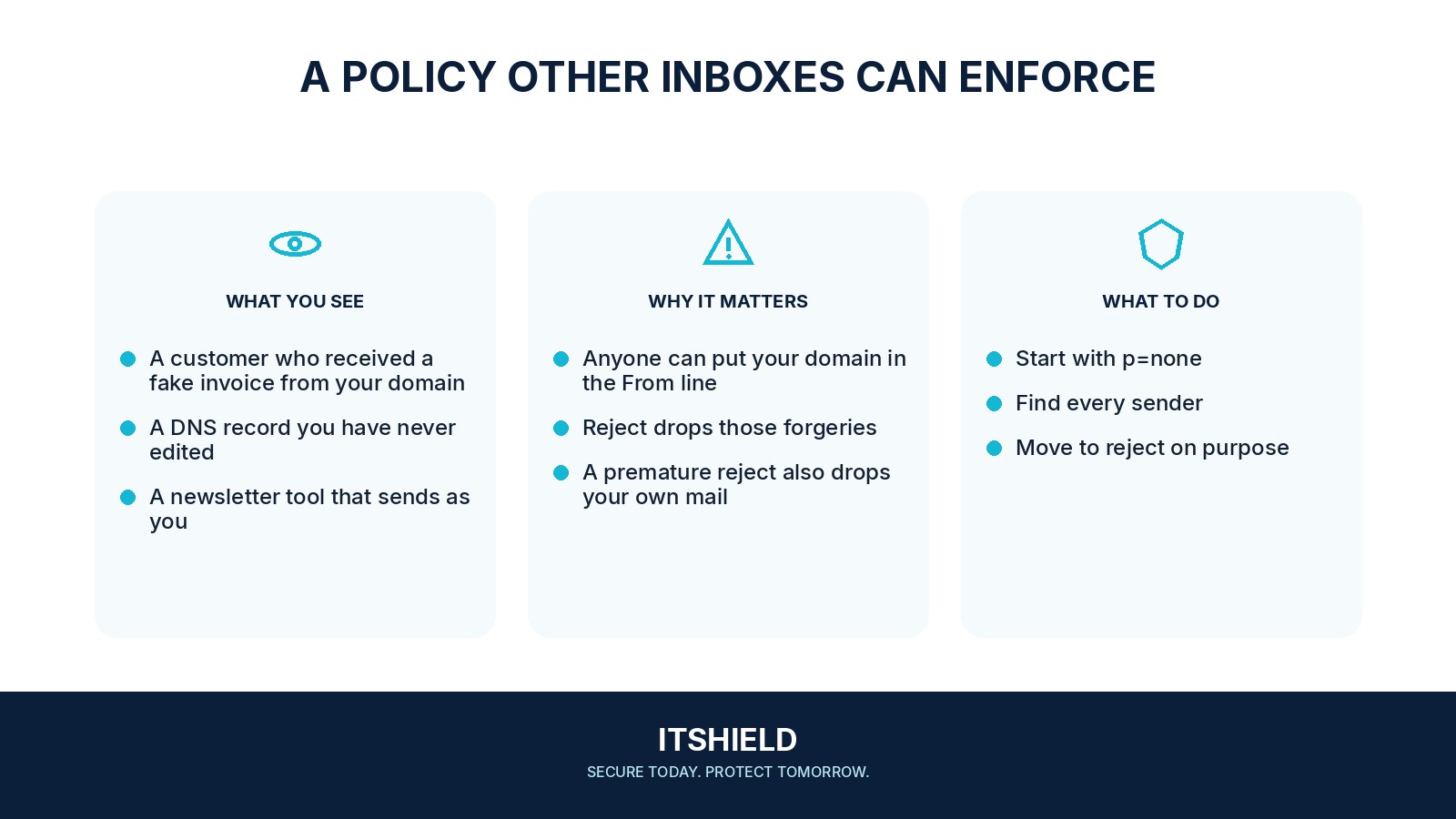
- Configure SPF and DKIM appropriately for the actual sending services.
- Publish an initial DMARC policy and reporting destination using the provider's recommended process.
- Review representative reports and test important sending workflows, including less frequent billing or campaign systems.
- Correct legitimate failures before moving toward quarantine or reject as appropriate.
- Maintain a sender-change process so a new marketing or support tool is reviewed before it begins sending.
How to check the result
Review actual delivery and authentication results for each legitimate sender. DMARC reduces some forms of domain impersonation; it does not prove that every authenticated message contains a safe business request.
Can we publish a strict policy immediately?
First check all legitimate senders, including infrequent ones. A policy that rejects your own invoices or support mail needs investigation and a controlled rollout.
Sources and useful guides
The following resources provide background and more detailed guidance. Use the sections that match your service and situation.