
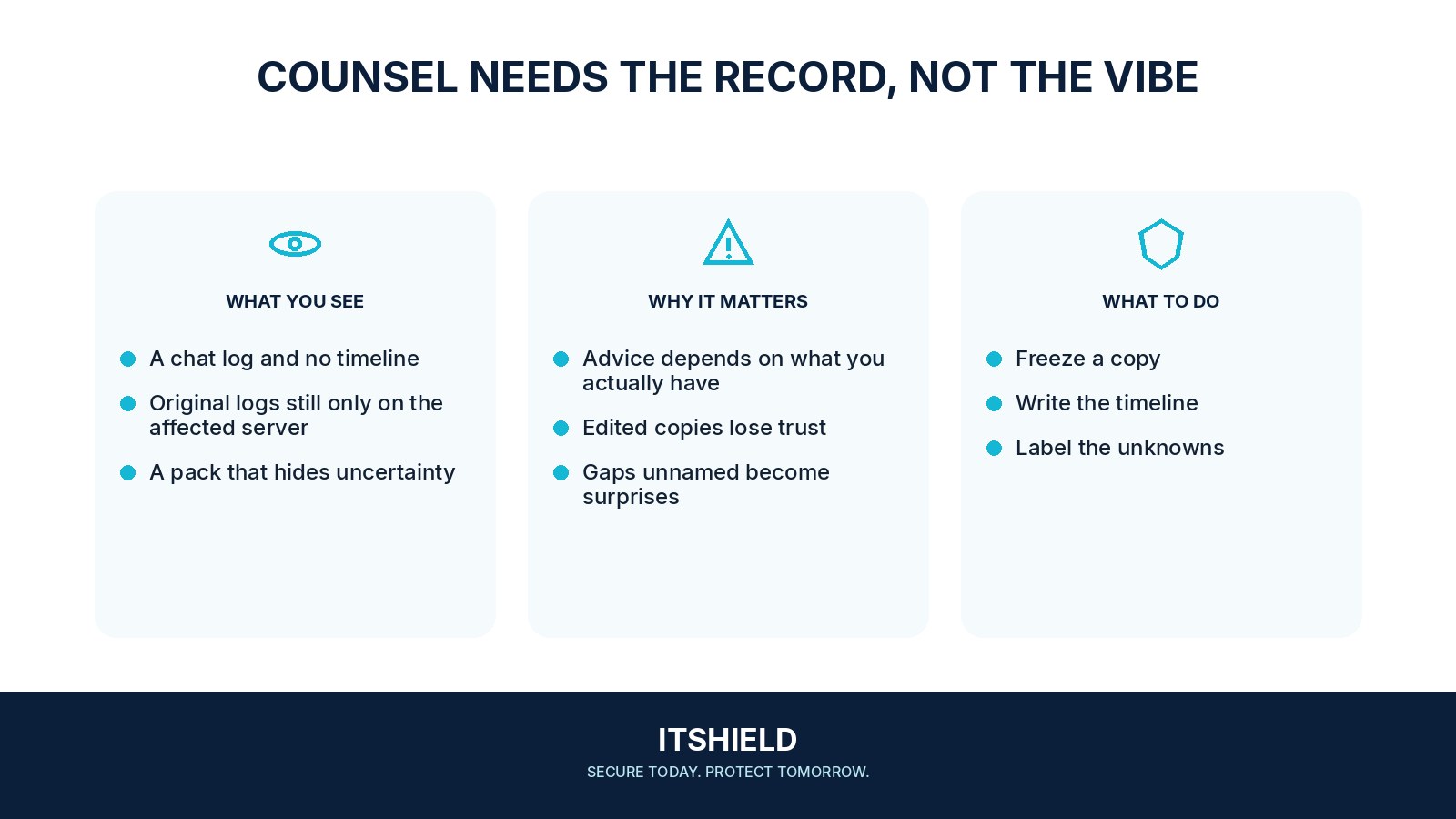
An evidence pack for legal review should help an authorized adviser understand the facts and their sources. It is not improved by adding every available document. A clear timeline, controlled originals, and an explanation of gaps are easier to assess than an unexplained mass of files.
Understand the idea
Ask the legal reviewer to direct the relevant scope and handling requirements. Keep source material distinct from analysis and assumptions. Record collection details, access, important decisions, and the link between a statement and the evidence supporting it. Do not assume that adding a legal label creates special protection.
- Index
Explain the material, its source, and what question it answers.
- Context
Preserve time ranges, collection methods, and limitations.
- Handling
Control access and follow the agreed preservation route.
A practical example
Imagine an incident lead preparing account activity for counsel. The pack includes the original provider export, a dated timeline, collection notes, and a list of unresolved questions. Each conclusion points to a source instead of relying on the incident lead’s memory.
What to do next
- Timeline: Original timestamps, time zones, normalized working times, and any clock uncertainty.
- Source register: Systems, export methods, queries or scope, collection times, and collectors.
- Evidence index: File identifiers, integrity information where appropriate, storage location, and handling record.
- Actions and decisions: What was changed, who approved it, why, and when.
- Known gaps: Missing logs, unverified assumptions, collection limits, and open questions.
- Contacts: Technical owners, suppliers, responders, and the authorized legal contact.
How to check the result
Have an authorized reviewer trace a sample fact to its original record. Confirm distribution, retention, and any legal-handling instructions with the appropriate adviser.
Can we claim a document is legally privileged just by labelling it?
Do not assume a label establishes legal protection. Ask counsel to determine the applicable legal treatment and the appropriate handling and distribution.
Sources and useful guides
The following resources provide background and more detailed guidance. Use the sections that match your service and situation.